Daily Habits to Protect Your Eyesight Naturally: 10 Steps
Independent guide · affiliate disclosure: RetinaClear.com is an independent publisher, not the manufacturer or seller. Some links on this page are affiliate links and we may earn a commission — at no extra cost to you — if you buy through them. This article is general information, not medical advice.
| The idea | You cannot rewind a prescription, but the daily habits you keep genuinely support the long-term health and comfort of your eyes. |
| The big levers | Screen breaks, UV protection, sleep, hydration, an eye-healthy diet, not smoking and regular exams. |
| Easiest win | The 20-20-20 rule plus a proper pair of UV-blocking sunglasses. |
| Nutrition support | Lutein, zeaxanthin, omega-3s and antioxidants — from food first, topped up by a daily formula if needed. |
| Habits are prevention | Good habits reduce risk over years. They do not treat a symptom that has already appeared, and they never replace an eye examination. |
| Call emergency services | Sudden blurring or double vision alongside headache, weakness, facial droop or slurred speech can be a stroke. |
| Same-day eye assessment | Sudden loss of vision, a dark curtain or shadow across your sight, a burst of new flashing lights, a sudden shower of floaters, or severe eye pain. |
| Also urgent | Any blow to the eye, a penetrating injury or a chemical splash. Irrigate a chemical splash with clean water immediately, then get help. |
| Not a supplement question | None of the above is treated by a dietary supplement. RetinaClear is not a treatment, drug or cure for macular degeneration, glaucoma, cataract, diabetic retinopathy or any other eye disease. |
Can you really protect your eyesight naturally?
Let us be honest up front: no habit will turn a short-sighted eye into a perfect one, and daily routines are not a replacement for glasses, contacts or professional eye care. But that is not the same as saying habits do not matter. The health, comfort and long-term resilience of your eyes are shaped every single day by how you use them, what you feed them, and how well you protect them from the things that wear them down. This guide gathers the daily habits to protect your eyesight naturally into one practical, ten-point routine you can actually keep.
The best part is that these habits overlap with a generally healthy life. What is good for your heart and brain — not smoking, moving your body, eating colour, sleeping well — turns out to be good for your eyes too. So none of this is a special burden; it is mostly a matter of pointing habits you already care about in a slightly more eye-friendly direction.
The 10-point daily eye-care routine
1. Give your eyes regular screen breaks
Close-up screen work is the defining eye strain of modern life. The simplest counter is the 20-20-20 rule: every 20 minutes, look about 20 feet away for at least 20 seconds. It relaxes the focusing muscles and prompts a few full blinks. Our dedicated guide on how to reduce eye strain from screens goes deeper on set-up and lighting.
2. Blink fully and manage dryness
Focused work halves your blink rate, which dries the tear film. Consciously blinking completely, keeping rooms from getting too dry, and reaching for preservative-free artificial tears when needed all help. If dryness is a daily theme for you, read why your eyes feel dry and tired.
3. Wear sunglasses that block UV
Ultraviolet light contributes to long-term changes in the lens and surface of the eye, and the damage is cumulative. Wearing sunglasses labelled to block UVA and UVB — plus a brimmed hat in strong sun — is one of the most genuinely protective everyday habits there is. Do it year-round, not just in summer; snow and water reflect a lot of UV too.
4. Get outside every day
Time outdoors gives your eyes distance focus and natural light they rarely get indoors, a welcome counterweight to hours at close range. In children, more outdoor time is associated with healthier vision development, and for adults it is simply a restful reset for the focusing system. A short daytime walk ticks several boxes at once.
5. Eat a colourful, eye-healthy diet
Your eyes are built and maintained from what you eat. Leafy greens, orange and yellow vegetables, oily fish, eggs, citrus and berries supply the carotenoids, omega-3 fats, vitamins and minerals the retina and macula depend on. Our full guide to the best foods for eye health and vision turns this into an easy, food-first plan.
6. Stay hydrated
The tear film is mostly water, so steady hydration through the day supports a smooth, comfortable eye surface. Sip water rather than relying on a couple of big drinks, and balance heavy coffee habits with extra water.
Make nutrient support part of the routine
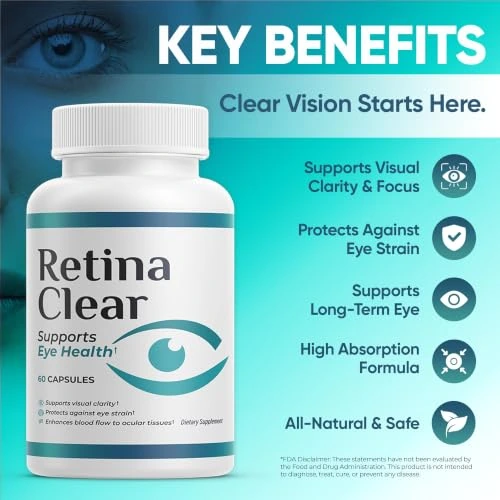
RetinaClear brings lutein, zeaxanthin and bilberry together with a full spectrum of vision vitamins and minerals in one simple daily capsule — an easy anchor for your eye-care routine, backed by a 60-day money-back guarantee.
See RetinaClear Packages7. Prioritise good sleep
Your eyes do much of their surface repair and rehydration overnight. Skimp on sleep and you begin the day with a tear film that has not fully recovered, which is why tired eyes and short nights go hand in hand. Aim for a consistent sleep schedule and a slightly cooler, darker, less dry bedroom.
8. Do not smoke
Smoking is one of the most consistently identified modifiable risk factors for age-related eye conditions. If you smoke, stopping is among the single most powerful things you can do for your long-term vision. If you do not, that is one big box already ticked.
9. Move your body
Regular physical activity supports healthy blood pressure, blood sugar and circulation — all of which matter to the tiny blood vessels that feed the retina. General cardiovascular health and eye health travel together, so the walk that helps your heart helps your eyes.
10. Get regular eye exams
The habit that underpins all the others. Comprehensive eye exams keep your prescription current (a huge factor in day-to-day clarity) and catch changes early, including conditions that have no obvious symptoms at first. How often depends on your age and risk factors — see our guide to age-related vision changes after 40 for what to expect — but making the appointment is the point.
Where a daily supplement fits into the routine
Habits and food come first — every time. But even a solid diet has gaps, and some of the nutrients that matter most for the eyes are ones many people fall short on. The carotenoids lutein and zeaxanthin, for example, build the macular pigment that helps filter high-energy blue light, yet the body cannot make them, so they must come from diet or supplementation. Antioxidant nutrients such as vitamins C and E and zinc support the eye's tissues against the oxidative stress of a lifetime of light and oxygen.
A well-formulated daily supplement can help top up those gaps as part of the broader routine above. That is exactly the role of RetinaClear: a once-daily capsule pairing lutein and zeaxanthin with bilberry and more than a dozen supporting vision vitamins and minerals. It is not a treatment or a shortcut past healthy habits — it is the nutrient anchor those habits sit on. And because these nutrients build up gradually, the benefit comes from consistency, which makes it a natural fit for a daily routine.
One capsule, a full vision blend
Anchor your eye-care routine with lutein, zeaxanthin and a full-spectrum vision formula — made in the USA in an FDA-registered, GMP-certified facility. Best value on the multi-bottle packs.
Order RetinaClear Today
Building the routine so it sticks
Ten habits can sound like a lot, so do not try to install them all at once. Pick two or three that fit your day — say, the 20-20-20 rule, sunglasses whenever you step outside, and taking your supplement with breakfast — and let them become automatic before adding more. Anchoring a new habit to an existing one (drink water when you make coffee; look out the window at the top of each hour) is the most reliable way to make it stick. Small, repeated actions compound, and eyes reward consistency more than intensity.
| Who we are | An independent team that researches and reviews everyday eye-health and lifestyle topics in plain, practical language. |
| How we work | Every guide is fact-checked against reputable eye-care sources and kept current. Read more about us. |
What the research says about the habits that matter most
Of everything on a daily eye-care list, two habits carry the strongest evidence behind them: not smoking, and shielding the eyes from ultraviolet light.
A 2025 systematic review and meta-analysis in Medicine updated the evidence on risk factors for age-related macular degeneration, with age and smoking heading the list of what actually predicts it (PMID 39993131). A separate meta-analysis of observational studies put numbers on the risk of cataract in smokers (PMID 30528895). If either applies to you, start with our guide to how smoking affects your eyes and vision, because nothing else on a habit list moves the needle as far.
Ultraviolet exposure is the other well-documented one. A review in International Ophthalmology surveys ultraviolet light and ocular diseases, covering the cumulative front-of-eye damage that daylight exposure causes over decades (PMID 23722672). The practical follow-up is our guide to protecting your eyes from sun and UV damage.
The rest of the routine is quieter but still worth building: an eye-friendly plate, covered in the best foods for eye health and vision; enough sleep, since lack of sleep affects your eyes within a single night; and knowing which small nuisances are harmless, such as an eyelid that keeps twitching.
FAQ
What daily habits protect your eyesight naturally?
Key daily habits include taking regular screen breaks, wearing UV-blocking sunglasses outdoors, getting good sleep, staying hydrated, eating a colourful eye-healthy diet, not smoking, exercising, lighting your space well, spending time outdoors and getting regular eye exams. Together they support long-term eye health.
Can you improve your eyesight naturally?
Healthy habits cannot change a refractive error like short-sightedness — that needs glasses, contacts or clinical care. What good habits do is support the overall health and comfort of your eyes and help protect them over the long term. An up-to-date prescription is often the biggest single improvement in day-to-day clarity.
Does spending time outdoors help your eyes?
Yes. Time outdoors gives your eyes natural light and distance focus they rarely get indoors, and in children it is associated with healthier vision development. For everyone, outdoor breaks are a simple counterweight to close-up screen work.
Do vision supplements protect eyesight?
Supplements are not a substitute for habits or professional care, but nutrients such as lutein, zeaxanthin, omega-3s and antioxidants support eye health as part of a broader routine. A daily formula can help fill gaps a busy diet leaves.
How long until eye-healthy habits make a difference?
Some habits — screen breaks, hydration, good lighting — improve comfort within days. Others, like diet and nutrient support, work over weeks and months as they build up. The point is consistency: eyes reward steady routines rather than one-off efforts.
References
- Risk factors for age-related macular degeneration: Updated systematic review and meta-analysis (Medicine (Baltimore), 2025 · PMID 39993131)
- Risk of cataract in smokers: A meta-analysis of observational studies (Archivos de la Sociedad Espanola de Oftalmologia, 2019 · PMID 30528895)
- Ultraviolet light and ocular diseases (International Ophthalmology, 2014 · PMID 23722672)
- National Eye Institute — Keep Your Eyes Healthy
- NIH Office of Dietary Supplements — Zinc fact sheet
- National Eye Institute. “Keep Your Eyes Healthy” and “Healthy Vision Tips.” nei.nih.gov.
- American Academy of Ophthalmology. “Eye Health Tips” and “UV Protection.” aao.org.
- American Optometric Association. “Guide to Eye and Vision Health.” aoa.org.
- Centers for Disease Control and Prevention. “Keep an Eye on Your Vision Health.” cdc.gov.
† These statements have not been evaluated by the Food and Drug Administration. This product is not intended to diagnose, treat, cure or prevent any disease. This article is for general information only and is not medical advice; consult a qualified eye-care professional about your individual needs.